In-house vs outsourced dental front office: the real comparison
Most comparisons put a salary next to a monthly fee and stop there. That understates in-house cost by a wide margin, and it is not close.
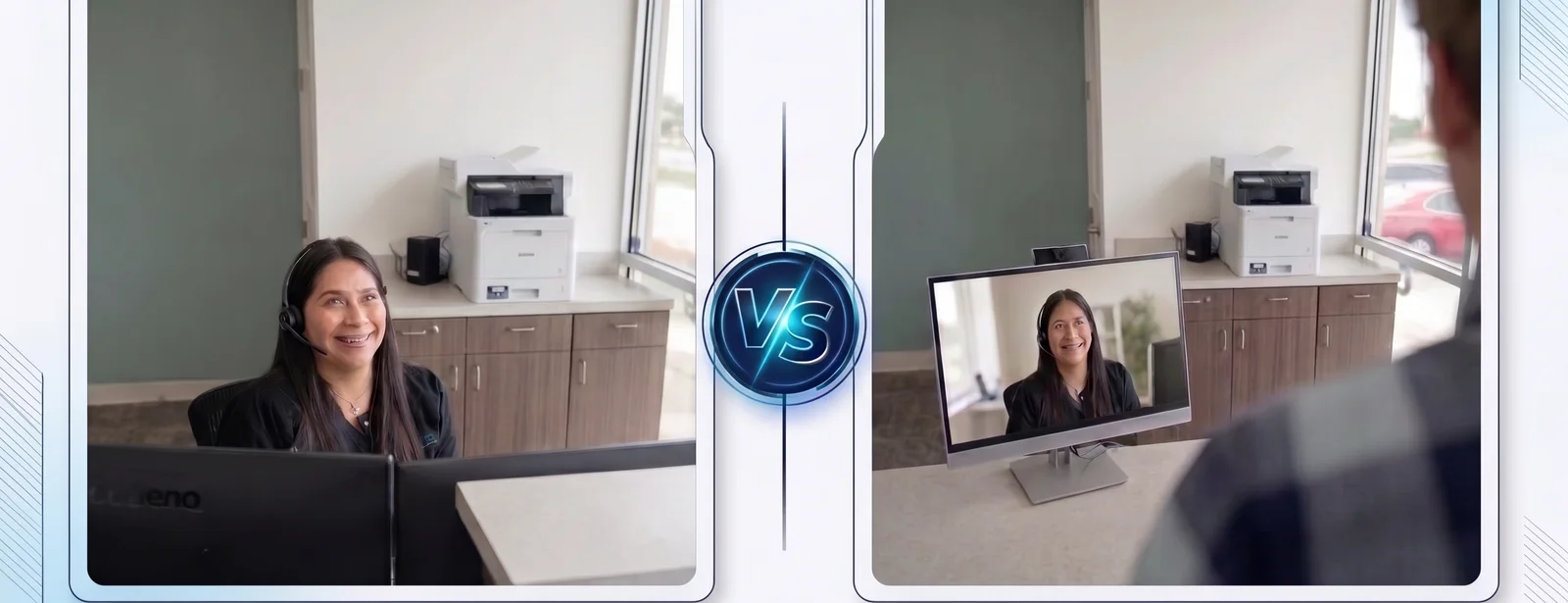
What in-house actually costs
Salary is the visible part. The fully-loaded figure includes:
- Payroll taxes and benefits
- Paid time off, and who covers the desk during it
- Recruitment cost per hire: advertising, screening, interview time
- Training time, including the productivity of whoever is doing the training
- The ramp period before a new hire is genuinely independent
- Software seats and workstation cost
- Management attention, which is real even though nobody invoices for it
Dental office manager and front desk salary in Texas
The salary is the one number every comparison includes, so it is worth getting right. Across 312 Texas dental job postings that listed pay in October 2026 (Google Jobs, Dallas, Houston, San Antonio, Austin, El Paso and the Rio Grande Valley), hourly pay annualized at 2,080 hours:
| Role | Postings with pay | Median per year | Middle half |
|---|---|---|---|
| Dental office manager | 55 | $54,000 | $45,760 – $57,500 |
| Insurance or billing coordinator | 63 | $42,000 | $35,360 – $48,880 |
| Front desk, receptionist, scheduling | 148 | $39,520 | $35,000 – $46,800 |
| All front-office roles | 312 | $43,680 | $37,440 – $52,000 |
Advertised pay is what it takes to get applicants, not what the seat costs. Payroll taxes, benefits and paid time off add roughly a fifth to a third on top, and none of it covers the weeks a seat is empty after someone leaves. The in-house vs outsourced calculator starts from the $43,680 median and lets you change every line.
The number nobody models
Front-office turnover is high across the industry. Every departure creates a gap where calls go unanswered, verification slips, and A/R ages, and then you pay the recruitment and ramp cost again. A practice that turns over its front desk twice a year is permanently operating with a partly-trained desk.
What in-house genuinely does better
This should not be a one-sided argument. In-office staff have advantages an outsourced team does not:
- They see the patient in front of them and read the room.
- They handle physical tasks: payments at the desk, forms, walking a patient back.
- They pick up context in the hallway that never gets written down.
- Continuity of relationship with long-standing patients is genuinely valuable.
Which functions outsource well
The ones that are repetitive, measurable, and do not require physical presence:
- Inbound call handling and booking
- Insurance verification ahead of the schedule
- Claim follow-up, denial rework and A/R recovery
- Outbound recall, reactivation and treatment-plan follow-up
The ones that do not: anything needing physical presence, and anything requiring judgment about a specific patient relationship built over years.
The hybrid most practices land on
Keep an in-office lead who owns the room and the patient relationship. Move the volume work (phones at peak, verification, claims, dental patient recall) to a dedicated team with protected hours. That combination usually beats either extreme, because it plays to what each side is actually good at.
Questions
Will patients know they are talking to an outsourced team?
They should experience it as your practice: your scripts, your scheduling rules, your name. What matters is whether the agent can actually resolve the call, which depends on system access, not location.
What about HIPAA with an offshore team?
A BAA is legally required regardless of where the team sits, and the same technical safeguards apply. Offshore is not inherently less compliant. It is inherently more scrutinized, which is why documented controls matter. See our Security & HIPAA page.
Can we start with one function?
That is the sensible approach. Start with one workstream, measure it, and expand only if it works. Any vendor pushing an all-or-nothing switch is optimizing for their revenue, not your risk.