The ADA dental claim form, box by box
Most dental claims are now sent electronically, but they are still built on the ADA form's structure. Knowing which boxes payers actually check is the difference between a claim that pays and one that comes back for information.
Part of Dental insurance, the full set of pages on this topic.
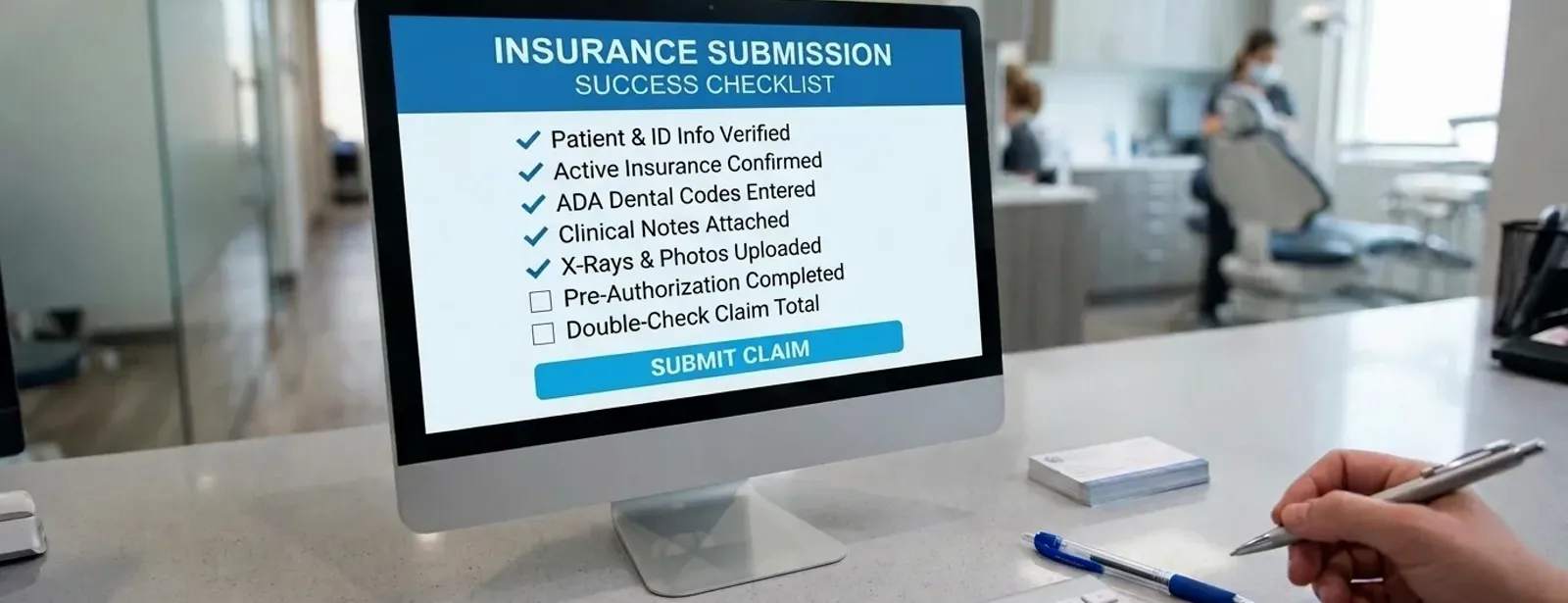
The ADA Dental Claim Form is the standard paper claim for dental services in the US, maintained by the American Dental Association and revised every few years. Electronic claims (the 837D transaction) carry the same information in a different wrapper, so even a practice that never prints a claim is filling in this form every day through its practice management system. When a claim is rejected for missing or invalid information, the fault is almost always in one of a handful of boxes.
The form's sections, in order
| Boxes | Section | What goes wrong |
|---|---|---|
| 1–2 | Header: type of transaction, predetermination number | Sending an actual claim marked as a predetermination, or the reverse |
| 3 | Primary payer name and address | An old address or payer ID after a plan change |
| 4–11 | Other coverage | Secondary coverage left blank when the patient has it, which delays both claims |
| 12–17 | Primary policyholder | Subscriber name or ID that does not match the payer's record exactly |
| 18–23 | Patient | Relationship to subscriber wrong; patient date of birth mistyped |
| 24–35 | Record of services, missing teeth (33), diagnosis codes (34–34a), remarks (35) | Missing tooth number or surface, wrong area of the oral cavity, no diagnosis pointer where one is needed |
| 36–37 | Authorizations | Patient and assignment of benefits signatures missing on file |
| 38–47 | Ancillary claim information | Enclosures not indicated, prosthesis replacement date missing, accident fields not completed |
| 48–52A | Billing dentist or entity | NPI, TIN or address not matching what the payer has on file |
| 53–58 | Treating dentist | Treating provider's NPI or license number missing, or the wrong provider for the date of service |
The record of services: where most claims fail
Each line in the record of services is one procedure: the date, the area of the oral cavity, the tooth system, the tooth number or letter, the surfaces, the procedure code, a diagnosis pointer where used, the quantity, a short description and the fee. Payers reject lines rather than whole claims more often than people realize, so one incomplete line can hold up a claim that is otherwise clean.
- Tooth number and surfaces are required for restorations, crowns and endodontics. A crown line without a tooth number is a rejection, not a denial: it never reaches adjudication.
- Area of the oral cavity is required for procedures done by quadrant or arch, such as scaling and root planing. See periodontal codes for how D4341 and D4342 are reported by quadrant.
- Quantity matters for codes billed per unit, such as additional films or per-tooth sealants. A missing quantity is read as one.
- Diagnosis codes and pointers are needed when the payer requires them, which is increasingly common for procedures that can cross into medical. Our page on dental ICD-10 codes covers when.
- The fee is your full office fee, not the contracted amount. The payer applies its fee schedule; billing the contracted fee forfeits any increase in it.
Missing teeth, remarks and enclosures
Box 33 records missing teeth, and it decides more claims than its size suggests. For a bridge, implant or partial, the payer uses it to apply the missing tooth clause and replacement rules, so a blank box 33 on a prosthetic claim invites a request for information. Box 35, remarks, is where a short narrative goes when the procedure needs one, though longer narratives belong in an attachment. The ancillary section asks whether enclosures such as radiographs or periodontal charting are included; marking that they are, and then not sending them, is a common reason a claim stalls.
What a reviewer needs to see in that narrative is set out in our guide to dental claim narratives.
Where to get the official ADA claim form (PDF)
The American Dental Association publishes the form and keeps the current version on its own claim form page. At the time of writing that page offers the current 2024 version as a sample PDF, the full completion instructions for every item on the form, and a route to order printed pads through the ADA store. We do not host or copy the form: the ADA page is the place to get the current version, and it changes when the ADA revises the form.
Billing versus treating dentist
The billing entity is who gets paid: usually the practice, identified by its group NPI and tax ID. The treating dentist is who performed the procedure, identified by an individual NPI and license number. In a group practice these are different, and the most common provider-level rejection is a treating dentist the payer does not have credentialed for that location, or an associate billed under the owner's individual NPI. When a provider joins or leaves, the claim form is where it shows up first.
Before you submit: a short check
- Patient and subscriber details match the record from dental insurance verification services exactly, including date of birth and ID.
- Secondary coverage is completed when the patient has it, with the correct order under coordination of benefits.
- Every service line has the tooth, surface or area it needs, and a quantity where the code is per unit.
- Attachments the procedure needs are actually attached, and the enclosures box says so.
- The billing and treating provider identifiers are the ones the payer has on file for this location and date.
Questions
Where do I get the ADA dental claim form?
The form is published by the American Dental Association, which sells printed forms and licenses the layout to practice management software and clearinghouses. Most practices never need a blank paper form: the claim is generated by their software and sent electronically, and the paper version is printed only when a payer requires it.
Is the ADA claim form the same as the CMS-1500?
No. The ADA form is for dental claims to dental payers. The CMS-1500 is the medical claim form, used when a dental procedure is billed to a medical plan, for example an oral appliance for obstructive sleep apnea.
What is the difference between a rejected and a denied claim?
A rejection means the claim failed basic checks and was never adjudicated, usually for missing or invalid information on the form. A denial means the payer adjudicated it and decided not to pay. Rejections are fixed by correcting the form and resubmitting; denials need a corrected claim or an appeal.
Do I have to send x-rays with every claim?
No, only for procedures the payer requires them for, which commonly include crowns, some periodontal procedures, extractions and anything by report. Sending them when they are not needed does no harm; not sending them when they are needed delays the claim.